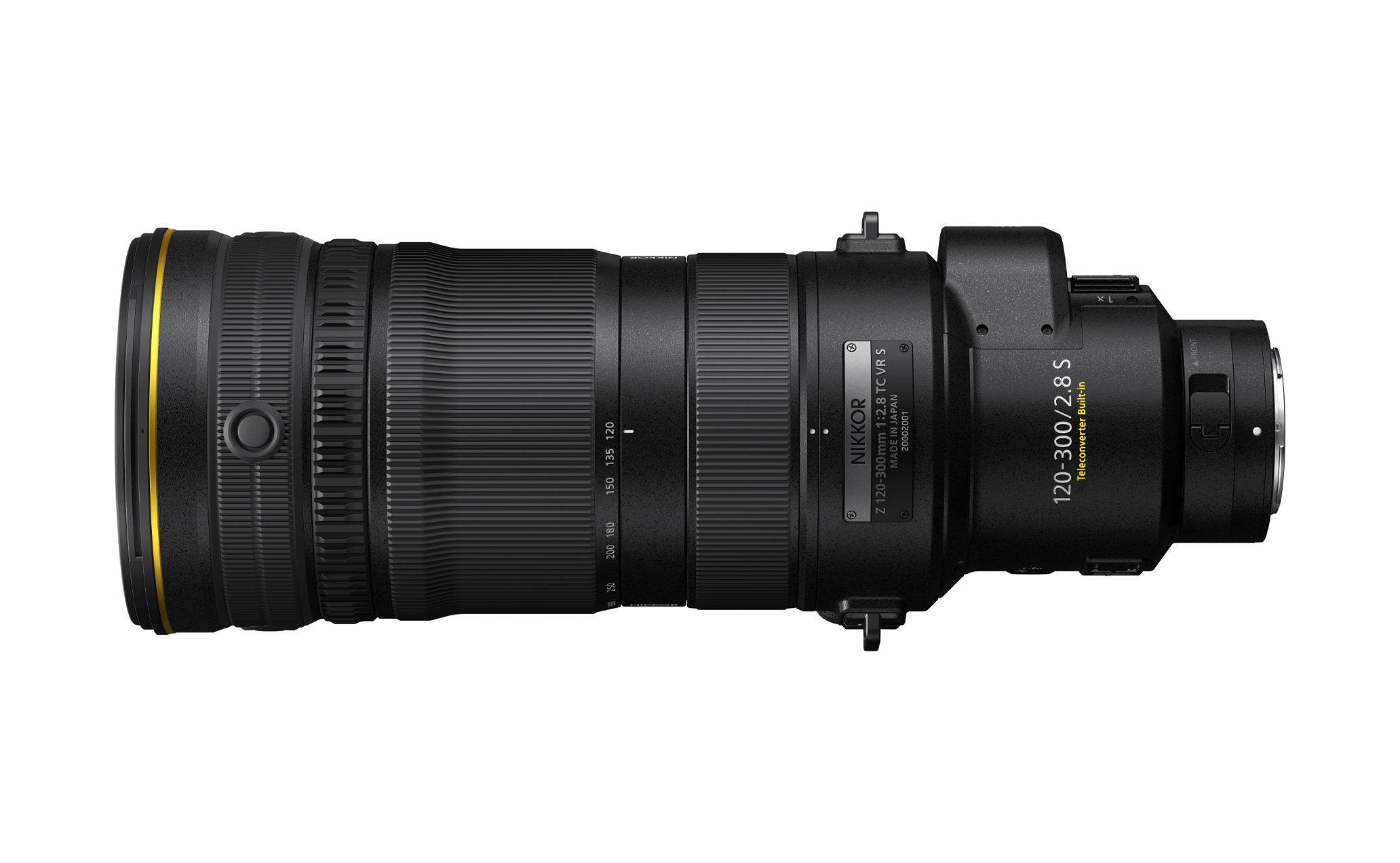
Nikon has released the NIKKOR Z 120-300mm f/2.8 TC VR S — the world's first telephoto zoom with a constant f/2.8 maximum aperture and a built-in 1.4× teleconverter (Nikon press room, October 29, 2026). Flip one switch and the lens's reach jumps from 300mm to 420mm with no quality cliff and no extra glass on the front of the camera. It's the third Z-mount lens with an internal TC and the first zoom to do it — and it lands, predictably for this tier, at a $13,999.95 U.S. suggested retail price, available from mid-November.
The spec sheet, at a glance:
120–300mm, constant f/2.8 (f/4 with the built-in TC engaged: 168–420mm), f/22–f/32 minimum aperture
30 elements in 24 groups — including 8 elements in 5 groups inside the teleconverter, with 1 ED, 1 Super ED, 1 aspherical, 1 fluorite and 1 SR element; Meso Amorphous Coat (Nikon's best anti-reflection coating to date) plus ARNEO Coat to kill flare
Silky Swift VCM (SSVCM) autofocus — VCM plus Nikon's guide mechanism — for tracking athletes at distance
6.5 stops of VR at center and edges (CIPA 2024, measured on the Z6III with Synchro VR, telephoto end)
Internal focusing and internal zoom — the barrel never changes length while you work
Arca-Swiss-compatible tripod collar with rubber cushion and integrated finger grip; magnesium alloy body, dust- and drip-resistant
112mm front filter thread plus a 46mm rear slip-in filter holder; HB-120 bayonet hood included; 2,735 g (6 lb 0.5 oz)
$13,999.95 U.S. SRP; mid-November 2026 availability (pre-orders were already moving at B&H and Adorama, shipping from around November 12)

The detail: Nikon has been putting built-in TCs in fixed-throw primes — the 400mm f/2.8 and 70-200mm f/2.8 both carry them — and this is the first time one rides inside a zoom. The appeal is obvious from the geometry: instead of deciding between a 120-300 and a 400-class reach, you carry one lens that is both, with the TC as a one-action switch. Nikon claims prime-level rendering across the frame even with the TC in, and the weight math backs the convenience angle — 2,735 g makes it roughly 515 g lighter than the AF-S 120-300mm f/2.8 from 2020, which had no TC in it. The 6.5-stop VR figure is measured on the Z6III, so that's the body to pair it with if you want the full stabilization number.
Our take: at $13,999 this isn't a conversation most of us are having — it's priced above the fixed Z 400mm f/2.8 TC VR S, and the buyers are the working sports and wildlife professionals who'd otherwise be flying between two heavy whites. The interesting parts for everyone else are the byproducts: the TC-inside-a-zoom architecture, SSVCM's speed, and 6.5 stops of VR on a 300mm-class lens are all Z-mount capabilities that keep trickling down the line. If you shoot video on Z, the practical overlap is real — a 6.5-stop-stabilized f/2.8 telephoto is a one-person-crew weapon at weddings, events, and long-lens B-cam coverage, and 120-420mm in one body is a range that covers most of that work. But the honest arithmetic is that the Z 400mm f/2.8 TC VR S has been sitting around $12,700 on sale, so the "new" lens is actually the more expensive one — you're paying for the zoom flexibility, and it shows. For the rest of us, the real story is watching what Nikon does with this optical recipe next, because built-in TCs are the kind of technology that eventually lands on a lens you can actually afford.
NIKON RED