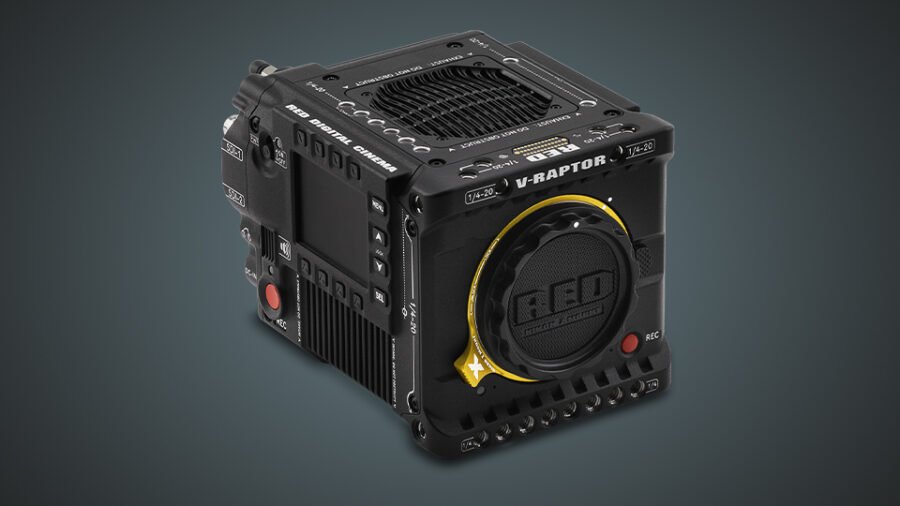
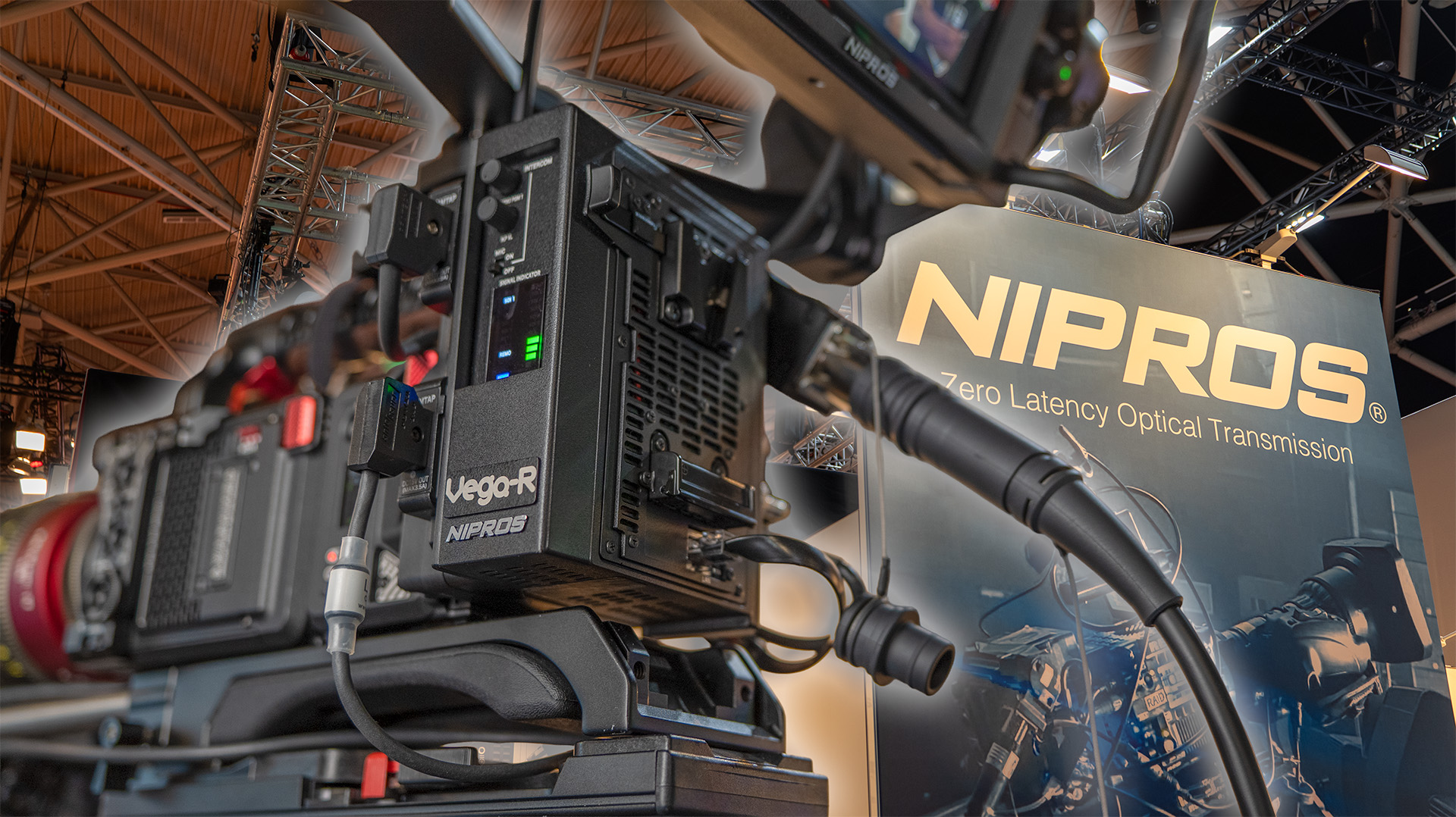
NIPROS, a Japanese broadcast gear maker with close to 35 years in video transmission, came to IBC 2026 with a product that finally fits the cameras we actually shoot on: the VEGA-R, a V-mount fiber adapter built around the RED KOMODO and KOMODO-X that puts the whole live chain — 12G-SDI, return video, genlock, timecode, intercom, tally, and Gigabit Ethernet — onto a single SMPTE fiber. CineD's Eric van Vuuren caught NIPROS's Greg Smokler at the booth to explain why the whole thing runs as pure analog light, and why that matters the second the cable gets bumped mid-show.
The VEGA-R bolts in between the camera and a V-mount battery, passing 14V through to the body while adding two P-Tap outputs. On the spec sheet it's one 12G-SDI input with a re-clocked through output, one 12G-SDI return, tri-level genlock and timecode on BNC, a 12-pin RS-422/RS-232C serial port, LANC, a 1Gbps RJ45, a voltage tally, and a 4-wire headset intercom on 4-pin XLR. The run to the base station is a LEMO SMPTE 304M hybrid cable, rated to roughly 600m (1,969ft) when the adapter is powered from the base station. The magnesium housing is about 110 x 156 x 186mm and runs around 1.45kg (3.2lb), drawing about 20W at most.
Light in, signal out, nothing in between. Most digital fiber systems have to convert everything onto one digital scheme — which means a frame buffer, a gearbox, a conversion step. NIPROS does the opposite. Every input is turned into light on its own wavelength and turned back into an electrical signal at the other end, never digitized, compressed, or buffered along the way. As Smokler put it, the system "has no actual idea what a frame is." It treats each input like a cable. Frame rates, resolutions, analog and digital signals, audio, serial data, and Ethernet all ride side by side with no relationship to one another. No gearbox, no frame buffer — and the zero-latency figure is the company's claim across every signal in the chain, intercom and genlock included.
The question that kept coming back: what happens when genlock drops mid-show? On a digital chain, analog signals like genlock and timecode get folded into the same digital scheme as the video. Knock the cable, one of those signals glitches, and it can fall out of sync with the primary feed and stay that way until the system is refreshed or briefly unplugged — which, as Smokler noted, is not easy to do in the middle of a rock n' roll concert. Because every NIPROS channel is isolated on its own wavelength, that failure mode doesn't apply: a signal that's interrupted simply comes back when the cable is reconnected. Setup, in his words, consists of plugging in the cables.
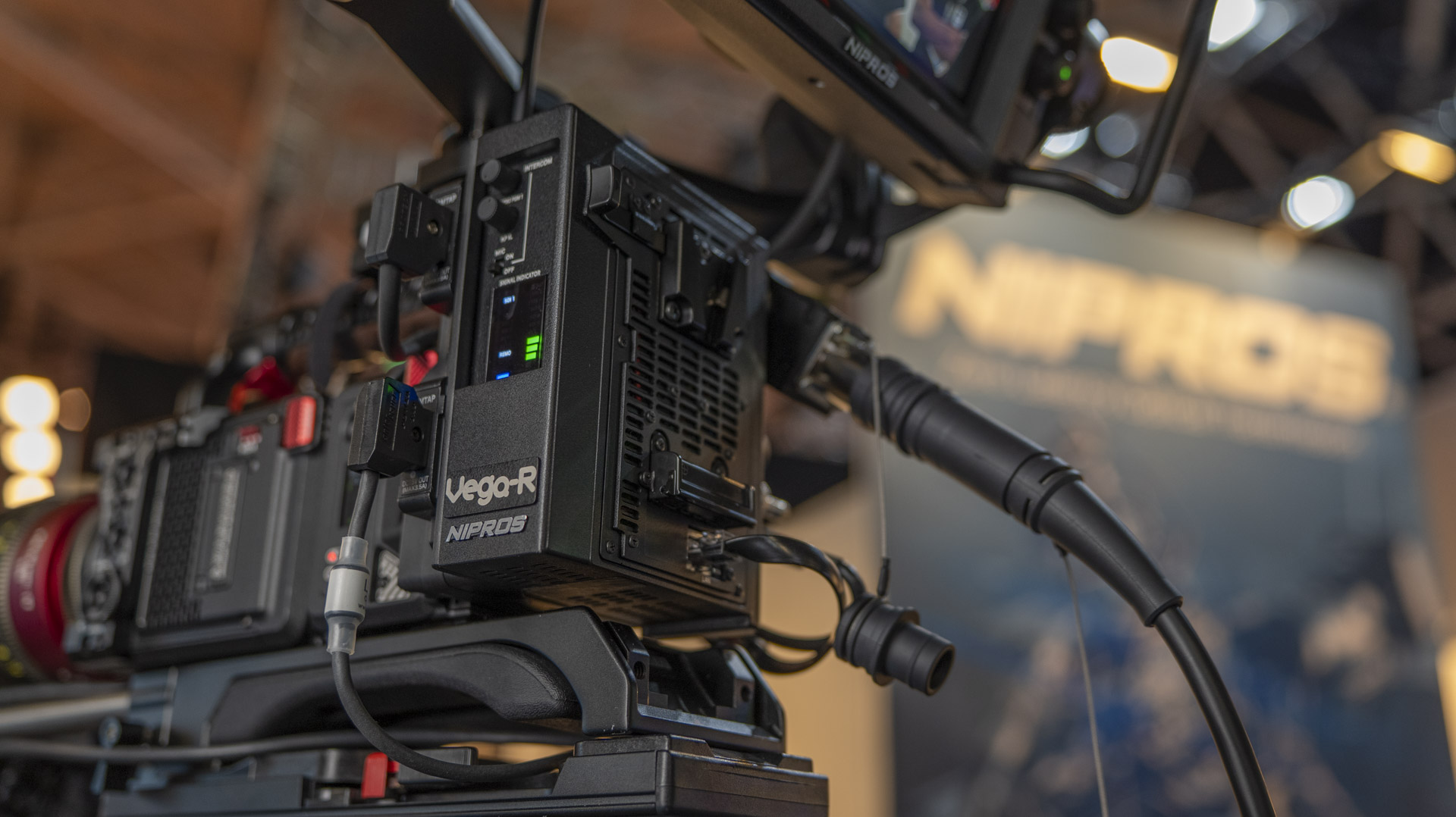
Why build it around the KOMODO? On the booth floor the VEGA-R was mounted on a RED camera, and NIPROS says it was designed with the KOMODO-X and KOMODO in mind because it sees those bodies getting adopted for live events, corporate work, and houses of worship — often in front of large LED walls, where the global shutter matters. The aim was a module priced for that customer while keeping the same transmission technology as the larger systems. Camera control runs through the EXT breakout cable or a USB-C-to-Ethernet adapter into the 1GbE port, which then drives RCP products or RED Control. RED itself has been adding live-production features to these bodies — the external tally trigger landed in firmware 2.2.4 — and NIPROS points out the VEGA-R isn't RED-exclusive: it describes the line as deployable on any camera. There's also a proprietary LENS port, a dedicated tunnel that lets an iris controller connect at the base station and show up at the adapter's 12-pin LENS connector, behaving like the lens output of a conventional broadcast camera and able to power a servo grip.
Orion, Orion Pro, and the Sirius PTZ for the bigger cameras. The Orion is what Greg called the workhorse: two 12G-SDI inputs, a 12G return, an 8-pin Sony RCP connector alongside the 12-pin serial, LENS, LANC, and 1GbE ports, a dedicated port for the company's own viewfinders, and a choice of LEMO or Tajimi fiber connectors. There's a 14/24V version for high-draw cameras like the ARRI ALEXA 35, rated to about 170W at the camera adapter (the 24V output wants a B-mount adapter for ARRI). The Orion Pro is the model with the full set of audio and video options. And the Sirius PTZ adapters sit under a PTZ camera and connect and power it over fiber — Smokler singled out the Sony FR7, which shows up on things like the Super Bowl halftime show and major concerts, and can be awkward to wire without converter boxes and auxiliary power. The Sirius PTZ does 90W PoE++ (IEEE 802.3bt Type 4) with two 12G-SDI inputs, reference, timecode, serial control, tally, and intercom; the Pro MAX has two PoE++ ports, 170W total, which in his words can behave as a remote studio throw-down — enough power and I/O for a PTZ plus a tripod-mounted camera, with intercom, return video for a presenter, audio, and a tally light.
The feature he expects people to value most is intercom. A lot of productions have moved to wireless comms for convenience and are now running into congested RF spectrum. On most NIPROS units a 2-wire intercom plugs into a 3-pin port that also powers the belt pack, so a Clear-Com network for the camera team rides over the same fiber. Because the intercom channel is optically isolated and never digitized, there's no delay when the mic is keyed and the first syllable of an instruction isn't clipped — the difference between "tilt up" and "pan left" arriving intact. The VEGA-R itself is listed with a 4-wire headset intercom; the 2-wire capability comes as you move up to Orion and Orion Pro.
Price and availability. At the booth, Greg put the VEGA-R at roughly €9,000, the Orion at about €12,000 to €13,000, and the Orion Pro at around €15,000 to €17,000 depending on options; the Sirius PTZ range follows the same curve (€9,000 / ~€12,000 / ~€15,000). No US pricing at the booth. NIPROS prices the camera adapter and the base station as separate items — its Japanese distributor RAID lists each half of the VEGA-R at ¥900,000 before tax (around €5,000) — which indicates those euro figures refer to a complete system of adapter plus base station. The VEGA-R, Orion, and Sirius PTZ are shipping now, with Greg noting units can take a couple of weeks to build; the Orion Pro is due this fall, and he said orders placed now should arrive before the end of the year, accessories included.
Our take: this is the quiet half of the "cinematic live production" story we keep hearing about. RED and the other cinema manufacturers are building their own integrated live systems — we just watched the ALEXA 35 Live work Eurovision 2026 — and NIPROS's bet is that its adapters are universal, which is the thing that actually matters to the rental houses and system integrators who send out different cameras on different jobs. A KOMODO with a global shutter on a fiber chain in front of an LED wall, with zero-latency intercom and no genlock-hold-prayers, is a live rig that doesn't cost the price of a dedicated broadcast camera. At about €9,000 for the full VEGA-R system, this is an accessory budget, not a camera budget — and for the live / corporate / worship end of the KOMODO user base, that's a genuinely new door. Whether RED's own live tooling (external tally in 2.2.4, the cine-broadcast direction we've been tracking through IBC) ends up converging with third-party fiber like this is the question to keep an eye on. Watch this space.
NIKON RED