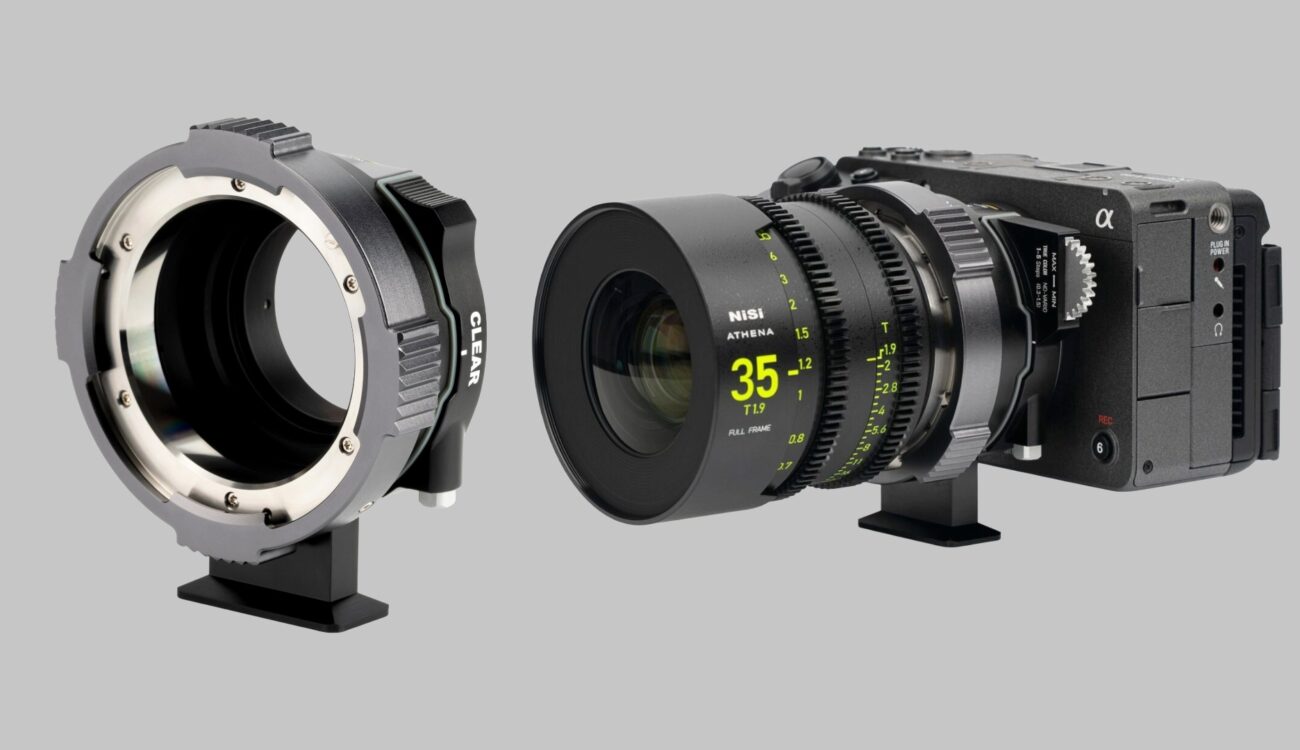
NiSi just moved the filter to the back of the PL lens — and the first mount on the way is the Nikon Z mount. The company has added a rear drop-in filter slot to its ATHENA PL adapters, in three flavors: PL-E for Sony E, PL-RF for Canon RF, and PL-Z for Nikon Z. On a ZR, a V-RAPTOR [X] Z Mount, or a KOMODO-X Z Mount, the drop-in glass now sits between the PL lens and the body — so one set of filters works on every PL lens in the kit, whatever the front diameter. It's the kind of small mechanical move that quietly rearranges a lot of rig budgets.
The adapters, by the numbers:
PL-Z for Nikon Z at 229g (PL-E 195g, PL-RF 207g), front and rear mounts in 304 stainless steel, with a sealing ring at the camera side to keep dust and moisture out.
Optical compensation for the filter in the path — NiSi says lenses still hit infinity focus with a drop-in installed, and each adapter ships with a clear filter so the path stays identical when you're not filtering.
The slot takes NiSi's ATHENA drop-in line: True Color VND (1–5 stops), True Color CPL, Black Mist, Allure Streak, and FS ND. The VND and CPL drop-ins carry 0.8 MOD gear, so a wireless lens motor (sold separately) can drive density or polarization remotely.
Fit: PL lenses with up to 25.8mm of rear protrusion. If you're mixing in glass from other manufacturers, NiSi tells you to check the rear element depth before buying — the long-rear-element cine primes are the classic gotcha.
Why behind the lens, not in a matte box? Because a rear filter means one VND covers the entire kit. The usual alternative for PL glass is a matte box with 4×5.65 or 6.6×6.6 inch plates — which means one set of expensive glass per front diameter, plus the whole box on the lens. And on very wide lenses a front filter is often just impossible. A $269 adapter that standardizes your filtering at the mount is a different ballgame, especially for the single-operator ZR crew that isn't running a full matte box pipeline.
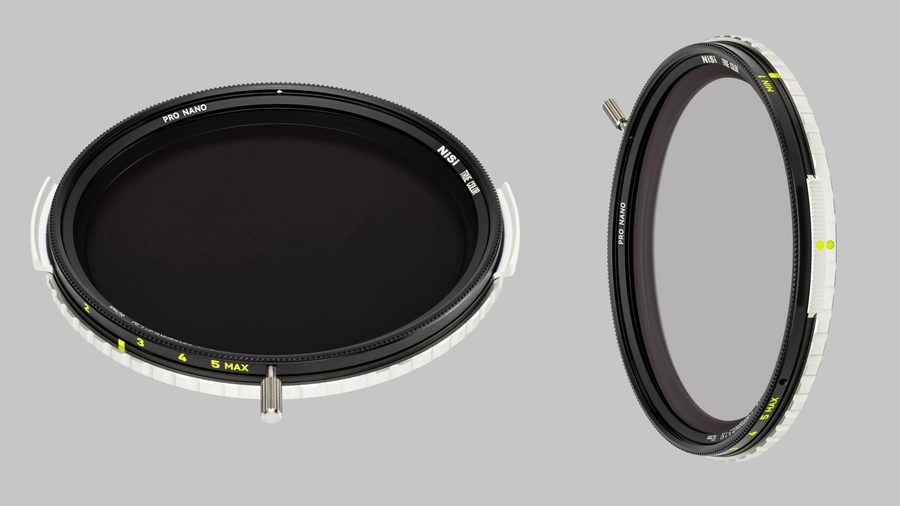
Alongside the adapters, NiSi released the True Color VND/PL — a screw-in filter from 49 to 95mm that combines a 1–5 stop variable ND with a polarizer, but with separate controls for each. That's the real trick: on a standard combo filter, adjusting the polarization changes your exposure, because both elements are linked in one rotation. Here, the polarization doesn't move the ND setting. NiSi caps the range at 1–5 stops (0.3–1.5) deliberately — go higher and cross-polarization gives you the X-pattern artifact. The glass is "True Color" neutral across the range (no magenta or warm cast), both elements carry multi-layer nano coating on all four air-to-glass surfaces that repels water and oil, and the slim aluminum frame is claimed to avoid vignetting on full-frame glass as wide as 15mm. Luminescent markings for low light, SWIFT-system compatible, aluminum front cap in the box. NiSi's own usage notes: shoot it at 35mm and longer (polarization goes uneven across the frame on wides), and don't adjust the polarizer at 4–5 stops or the colors get oversaturated.
Price and availability: the ATHENA Drop-In adapters (PL-E, PL-RF, PL-Z) are $269 each, clear filter included. A Filmmaker Kit for PL-E and PL-Z adds a True Color VND 1–5 and a Black Mist 1/8 drop-in plus a filter bag for $399. All three are pre-order now with no shipping date. The True Color VND/PL is available now: $209 for 72mm and $249 for 82mm in the US, €169–279 across the 49–95mm range in Europe. One gap for now: no drop-in version of the PL-L adapter, so L-Mount users are still out.
The honest caveat, straight from NiSi: the filter slot sits close to the camera body, and a cage, top plate, or positive-lock mount can restrict filter changes — or prevent fitting the adapter with a filter installed altogether. Their advice is to mount the adapter first, then insert the filter. So this is a committed-setup play: pick your rig, build it around the adapter, and leave the drop-in in. It is not a hot-swap slot you're cycling through filters on between setups, and if your cage is tight against the mount you may need to rethink the whole front of the rig. For a studio or fixed location that's a non-issue; for a one-person doc crew that swaps bodies and lenses all day, it's a real constraint.
Our take: the math is what makes this interesting. A matte box with a matched set of 4×5.65 filter plates is a $1,500–2,500+ outlay, and it only solves the problem for the lens it's matted. $269 for a stainless adapter that puts one set of drop-ins behind every PL lens you own is the cheapest standardization move in the Z-mount cinema ecosystem since the Z/PL adapters themselves landed. KipperTie got there first with its Revolva (we covered it when it launched), and its rotating four-position filter wheel is the same "filters at the mount" idea with a different mechanism — NiSi's drop-in approach just gives you a wider choice of glass, including true variable ND and diffusion, with motorized remote control on the table. For the ZR specifically, this matters more than for any other body in the line: the ZR is the $2,199 body that's already pulling double duty as a cinema camera, and a lot of that footage is PL glass on a mount adapter. A drop-in VND at the mount means you can run outdoor work without a matte box, keep the body small, and still get diffusion and ND in the path. Pair that with the NIKKOR Z CINEMA T1.9 VV primes Nikon is developing and the ecosystem is quietly completing itself: PL glass for the big bodies, native cinema glass coming for the AF side, and now filtering that fits a one-person rig. The cage caveat is the one reason not to buy blind — measure your setup first. Watch this space.
NIKON RED